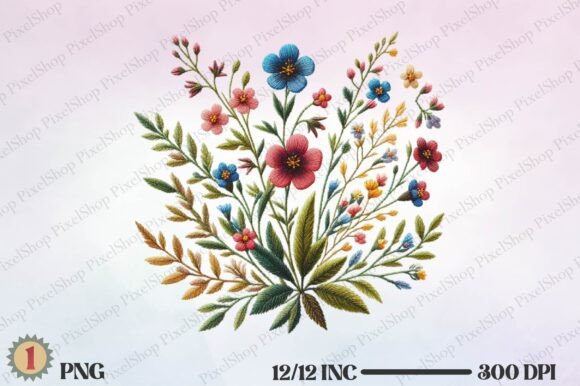
Watercolor Embroidery Wildflowers PNG
A Designer’s First Look: Soft, Lyrical, and Ready for Real Projects
As an embroidery designer who’s stitched everything from boutique baby blankets to limited-run apparel collections, I opened Watercolor Embroidery Wildflowers PNG expecting charm—but what stood out immediately was its quiet confidence. This isn’t a loud, high-contrast graphic; it’s a delicate illustration with gentle gradients, subtle blooms, and organic edges that mimic real watercolor washes. The transparent background means no clipping or layering headaches, and the 12×12 inch size gives breathing room for resizing without pixelation—especially important when adapting for smaller hoop work like caps or patches.
Fits Naturally Into Handmade Product Categories
Watercolor Embroidery Wildflowers PNG doesn’t scream “logo” or “monogram.” Instead, it leans into storytelling—ideal for products where softness, nature, and intentionality matter. Think: linen aprons for herbalists, organic cotton baby blankets, ceramic studio towels, botanical-themed pillow covers, or spring-themed tote bags sold at craft fairs. It also translates beautifully into nursery decor and personalized gifts—especially for mothers, gardeners, or teachers who appreciate understated elegance over trend-driven graphics.
How It Performs in Real Embroidery Work
This is where many illustrative PNGs stumble—and where Watercolor Embroidery Wildflowers PNG earns its place in my working library. Because it’s delivered as a clean, high-res PNG with transparency, it’s not locked into one stitch style. That flexibility lets me choose the right embroidery approach per project:
- For custom apparel (sweatshirts, tees), I convert it to a low-density fill stitch design—keeping the watercolor mood alive while ensuring durability through washes.
- On stretchy fabric like jersey or ribbed knit, I pair it with medium-weight cutaway stabilizer and reduce stitch density slightly to prevent puckering around petal curves.
- For caps and curved surfaces, I simplify outer flower shapes manually—removing fine interior lines that won’t resolve cleanly in a small hoop—and use satin stitch outlines to define shape without heaviness.
- On dark fabric, I test thread colors carefully: pale sage, dusty rose, and oatmeal tones hold up better than pure white, preserving the watercolor illusion without glare.
Practical Considerations for Small Business Owners
If you sell on Etsy or run a handmade shop, presentation matters as much as stitching. Watercolor Embroidery Wildflowers PNG elevates your product photography instantly—it reads as thoughtful, artisanal, and cohesive. When used across a collection (e.g., matching kitchen towel + apron + pillow cover), it builds brand consistency without needing a full logo system. Buyers notice that care. They also trust it more as a handmade product because the design feels intentional—not clipart-y or mass-produced.
That said, don’t assume it’s plug-and-play for every item. A dense version of this wildflower cluster could overwhelm a baby onesie or cap. For those, I treat it as a design asset, not a final embroidery file—I isolate single blossoms or stems, resize thoughtfully, and re-digitize with appropriate stitch types (running stitch for wispy stems, satin for petals). This extra step pays off in wearability and perceived value.
Where It Shines—and Where to Proceed With Care
Watercolor Embroidery Wildflowers PNG excels in applications that benefit from texture and subtlety:
- Tote bag design: Large surface area lets the full 12×12 composition bloom beautifully—especially on natural canvas or unbleached cotton.
- Pillow covers & nursery decor: The soft palette complements neutral interiors and photographs well against wood, linen, and wool backdrops.
- Embroidered patch production: When converted to applique design with fused backing, the wildflower shapes hold their character even after repeated laundering.
- Printable mockups: Its transparent background makes it ideal for creating realistic digital previews—great for Etsy listings or client approvals before stitching begins.
Proceed with care on:
- Tiny lettering or micro-details: The original PNG includes no text or fine linework—so avoid assuming it contains script, names, or borders unless added by you.
- High-stress seams or pocket flaps: Dense fill areas may need reduced stitch count or strategic placement away from fold lines.
- Commercial embroidery orders: Always verify licensing terms on the Creative Fabrica product page before selling finished items—especially if bundling with other design assets or offering as part of a subscription service.
Essential Embroidery Notes Before You Stitch
Even beautiful illustrations need smart execution. Here’s what I do before committing Watercolor Embroidery Wildflowers PNG to a customer order:
- Test on scrap fabric matching the final product’s weight, weave, and color.
- Compare light and dark fabric mockups—watercolor tones behave differently on black vs. ivory.
- Confirm hoop size compatibility: the full 12×12 layout needs a large hoop, but cropped versions work in 4×4 or 5×7 with careful digitizing.
- Use proper stabilizer—tear-away for stable wovens, cutaway for knits or textured fabrics like terry cloth.
- Inspect small details post-stitch: delicate stamen or leaf veins may need manual reinforcement if they vanish during dense fill.
- Review file details and license terms directly on the Creative Fabrica product page—especially if using for commercial embroidery, digital resale, or bundled kits.
Final Thought: A Quiet Upgrade for Your Creative Workflow
Watercolor Embroidery Wildflowers PNG won’t replace your go-to monogram or bold logo files—but it fills a meaningful gap. It’s the kind of Creative Fabrica embroidery asset that helps you say something quieter, warmer, and more personal. Whether you’re designing for a seasonal handmade gift line, building a botanical-themed boutique collection, or simply looking to add depth to your digital embroidery file library, this illustration delivers visual integrity without sacrificing practicality. It reminds me why I love this work: not just precision and technique, but the ability to translate feeling—like morning light on petals—into thread, fabric, and meaning.