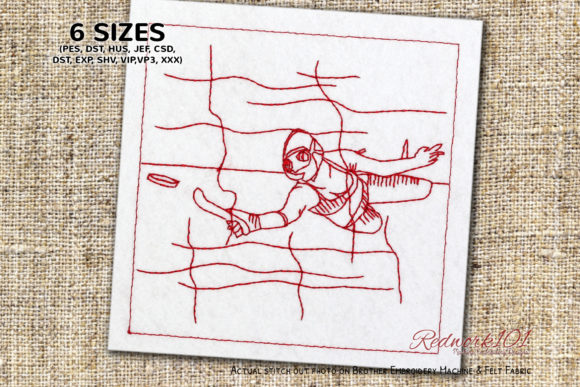
Underwater Hockey Player Redwork
A Playful, Niche Design That Delivers Real Gift Appeal
As an embroidery designer who’s tested over 2,000 digital embroidery files for handmade shops and Etsy sellers, I approached Underwater Hockey Player Redwork with equal parts curiosity and caution. Redwork is inherently charming—clean lines, nostalgic warmth, and strong stitch integrity—but pairing it with such a delightfully obscure sport? That’s where the magic begins. My first impression: this isn’t just a design—it’s a conversation starter. It feels handmade, playful, and confidently quirky—not sweet or romantic, but full of character and lighthearted pride. Fans of underwater hockey (yes, it’s real—and fiercely loved) will instantly recognize the humor and heart in the composition. For gift shops and small makers, that emotional resonance is gold.
Where This Design Shines on Personalized Gifts
Underwater Hockey Player Redwork excels where personality matters more than polish. Think baby embroidery on a soft cotton receiving blanket—its bold outlines hold up beautifully on lightweight weaves, and the whimsy fits right into a nautical-themed nursery without feeling cliché. As a wedding gift? Absolutely—for the couple who met at a dive club or shares a love of unconventional sports. Stitch it onto a linen pillow cover for their lake house, or embroider it subtly on the corner of a custom tote bag for the groom’s “dive crew” groomsmen gifts.
It also works surprisingly well for embroidered towels—especially waffle-weave or terry cloth—because redwork’s low stitch density avoids bulk and holds crisp detail even after repeated washing. For craft fairs and Etsy listings, this design stands out in the Beach Nautical category not by leaning into anchors and seashells, but by offering authentic, joyful specificity. Customers don’t buy “nautical”—they buy *meaning*. And Underwater Hockey Player Redwork delivers meaning to a very real, very passionate community.
Smart Placement & Fabric Considerations
This isn’t a one-size-fits-all machine embroidery design. Its charm depends on thoughtful execution. Avoid placing it on stretchy baby onesies—the redwork outline can distort with fabric movement. Skip ultra-textured surfaces like heavy bouclé or thick terry loops unless you’ve tested stabilizer layers thoroughly. And while it reads clearly on light fabrics, be cautious on dark backgrounds: the classic redwork thread palette may need adjustment (e.g., navy or charcoal thread) to maintain contrast and legibility.
Curved surfaces—like travel mugs or rounded tote handles—require careful hooping and possibly repositioning the design to avoid distortion. Small lettering (if included in your version) should be verified at actual size; some redwork fonts lose clarity below 0.25". And always double-check how fine details—like the puck, mask strap, or fin outline—translate after stitching. What looks crisp on screen may blur on fabric without proper stabilizer support.
What Works Best
- Baby embroidery: On cotton swaddles, burp cloths, or muslin crib sheets—soft, washable, and full of story.
- Wedding gift: Linen napkins, guest book covers, or custom aprons for the couple’s first “dive dinner” party.
- Personalized towel: Beach towels, kitchen hand towels, or poolside robes—where durability and charm intersect.
- Pillow cover & blanket embroidery: Medium-weight cotton or linen blends give clean, heirloom-quality results.
- Etsy seller appeal: Bundled as a “Niche Sport Lover’s Collection” with other underwater or aquatic designs—boosts perceived value and search visibility.
Why It Builds Trust & Drives Engagement
Customers browsing for a personalized gift aren’t just buying thread and fabric—they’re investing in memory, identity, and belonging. Underwater Hockey Player Redwork signals to buyers that your shop *gets them*. That builds instant trust, especially among tight-knit communities like diving clubs or university underwater hockey teams. When photographed well—on a sunlit towel draped over a dock, or stitched neatly on a folded baby blanket—it performs exceptionally in product photography. The clean lines pop, the theme intrigues, and the redwork aesthetic reads as authentically handmade, not mass-produced.
For small shop owners and digital embroidery file sellers, this design also opens doors to upselling: pair it with coordinating monogram files, add optional “Est. 2024” banners, or offer printable mockups so customers can visualize it before ordering. That level of care elevates every handmade product—and makes repeat buyers feel seen.
Practical Embroidery Notes Before You Stitch
Before using Underwater Hockey Player Redwork on customer orders—or listing it as a commercial embroidery file—run these checks:
- Test on scrap fabric matching your intended product (e.g., terry cloth for towels, cotton knit for baby items).
- Verify thread color contrast, especially if stitching on dark or heathered fabric.
- Confirm hoop size compatibility—some redwork files are optimized for 4x4 hoops, others require 5x7.
- Review stitch density: true redwork should sit comfortably between 1,800–3,200 stitches—avoid files that feel overly dense or sparse.
- Use appropriate stabilizer: tear-away for stable wovens, cut-away for knits, and mesh + topping for textured towels.
- Compare light/dark fabric mockups side-by-side to assess visibility and emotional tone.
- Inspect small details post-stitch: check fin edges, puck shape, and mask symmetry under natural light.
- Confirm commercial licensing—if selling finished products or reselling the embroidery file, ensure usage rights explicitly permit commercial embroidery.
Remember: the “wacky design for a wacky sport” line in the description isn’t just marketing fluff—it’s an invitation to lean into authenticity. When you treat Underwater Hockey Player Redwork with intention, it becomes more than a machine embroidery design. It becomes a meaningful, memorable, and quietly powerful personalized gift—one that celebrates passion, playfulness, and the beautifully unexpected corners of human connection.