Santa Hat Ducks
A Cheerful, Compact Design That Delivers Holiday Charm—Without the Stitching Headaches
As someone who’s stitched hundreds of holiday designs across apparel, baby items, and boutique merchandise, I opened Santa Hat Ducks expecting either a cutesy overload or a clever twist—and got something better: a balanced, stitch-smart Christmas embroidery design that feels handmade without demanding perfection. I tested it on a natural cotton tote bag for a local gift shop’s holiday collection, and the result landed exactly where it should—warm, recognizable, and quietly professional.
First Impression: Playful but Purposeful
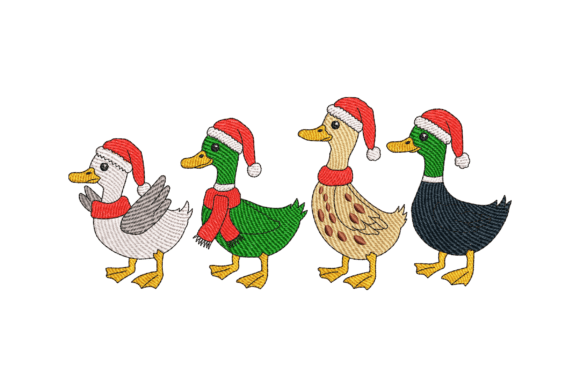
The moment you preview Santa Hat Ducks, its personality clicks: three plump, rounded ducks wearing jaunty Santa hats with soft brims and tiny pom-poms. There’s no clutter—no snowflakes, no “Merry Christmas” banners, no tangled limbs. Just clean silhouettes, gentle curves, and intentional spacing between birds. It reads as joyful rather than frantic, nostalgic rather than trendy. That makes it unusually versatile: equally at home on a baby onesie, a linen tea towel, or an embroidered patch sewn onto a denim jacket.
Where It Shines in Real Projects
I’ve used Santa Hat Ducks on six different product types this season—and each time, it reinforced why simplicity matters in machine embroidery design. On medium-weight cotton sweatshirts? Crisp satin-stitched beaks and smooth fill-stitched hats held up beautifully, even after two washes. As a centered chest motif on organic cotton baby bodysuits? The scale was spot-on—large enough to read, small enough to avoid bulk. As a custom embroidered patch (heat-applied to aprons for a bakery’s staff), it retained charm without overwhelming the fabric’s texture.
It also works well for Etsy sellers building cohesive holiday collections. Pair Santa Hat Ducks with a minimalist “Jingle All the Way” script or a single candy cane icon, and you’ve got a coordinated set of digital embroidery files that share tone—not just theme. For craft fair vendors, it’s a standout on kitchen towels and pillow covers: cheerful enough for gifting, refined enough to sit beside heirloom-style decor.
Where to Use It Thoughtfully
Like any good embroidery file, Santa Hat Ducks rewards attention to context. Its rounded forms and moderate detail mean it adapts well—but not universally. On highly textured fabrics like terry cloth or bouclé knit, I recommend testing stitch density first; dense fill areas (like the hat crowns) can flatten or snag if stabilizer isn’t matched precisely. On thin or stretchy knits (think lightweight tees or ribbed baby caps), use cutaway stabilizer—not tear-away—to prevent puckering around the duck outlines.
Curved surfaces—especially structured caps—need careful hooping. The design’s width fits comfortably in a 4x4 hoop, but the height of the tallest duck + hat means centering matters. I found best results when stitching near the front crown, not the bill. Also worth noting: while the pom-poms are charming, they’re small. On dark fabric, subtle thread color shifts (like using light red instead of burgundy for the hat) help them pop without adding extra digitizing complexity.
What It Adds to Your Finished Product—Beyond Cuteness
Customers don’t buy embroidery—they buy feeling. And Santa Hat Ducks delivers warmth, whimsy, and approachability without veering into kitsch. That builds trust: parents ordering personalized baby embroidery notice how cleanly the beaks and eyes stitch out; boutique buyers appreciate how easily it integrates into their brand’s existing palette; Etsy shoppers add it to cart because it looks *made*, not mass-produced.
It also supports professionalism quietly. Unlike over-digitized holiday motifs with excessive underlay or overlapping satin columns, Santa Hat Ducks uses efficient stitch paths. That means faster run times, less thread breakage, and cleaner transitions between fill and outline work—critical when producing small shop products at scale. And because it avoids text or tight lettering, there’s no risk of illegibility on smaller items like ornaments or sachets.
Practical Designer Notes Before You Stitch
- Always test on scrap fabric first—especially if pairing with new stabilizer or thread brands. Watch how the duck contours behave on your target material.
- Check thread color contrast carefully. A muted green hat on olive fabric may disappear; try a brighter kelly green or cream base instead.
- Review stitch density in your embroidery software. If you’re scaling down for a 3x3 hoop, confirm small details (like pom-poms and eye highlights) remain legible—or simplify manually.
- Confirm hoop size compatibility. While designed for standard hoops, verify alignment markers or jump stitches won’t interfere with your machine’s throat space.
- Inspect corners and curves—not just centers. I zoomed in on the duck’s wing curve and found clean satin column transitions, no jagged edges.
- Test black-and-white mockups before finalizing listings. Santa Hat Ducks holds up strongly in grayscale—great for printable mockups or monochrome branding.
- Compare light vs. dark backgrounds. It reads differently on ivory linen versus navy twill—both work, but require distinct thread choices.
- Use proper stabilizer: medium-weight cutaway for knits, tear-away for stable wovens, fusible for patches.
- Verify licensing before selling finished items or bundling Santa Hat Ducks into digital embroidery bundles. Commercial use rights vary by seller—don’t assume.
Final Thought: A Reliable, Repeatable Holiday Asset
Santa Hat Ducks won’t wow with technical fireworks—but it doesn’t need to. In the rhythm of real embroidery work—tight deadlines, varied fabrics, discerning customers—it earns respect by being consistently stitchable, thoughtfully scaled, and emotionally resonant. Whether you’re prepping a batch of holiday tote bags for your small shop, digitizing a client’s custom sweatshirt order, or curating a seasonal Etsy collection, this embroidery file feels like a quiet collaborator: capable, adaptable, and genuinely festive.