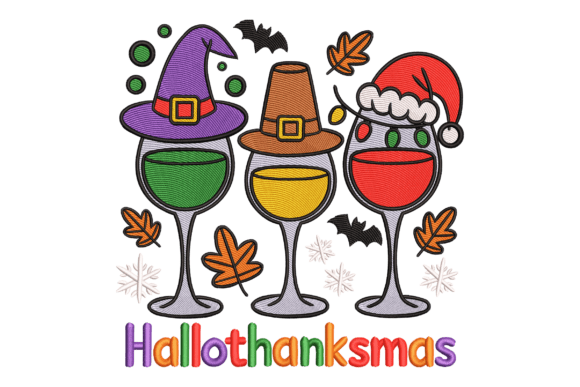
Christmas Wine Glasses Embroidery Design
A Practical Review for Small Business Merch & Branded Patches
As an embroidery designer who’s developed hundreds of commercial designs for cafés, boutiques, bakeries, florists, and handmade brands, I approach every new machine embroidery design with two questions: Does it communicate brand value at a glance? and Will it hold up—visually and structurally—across real-world business applications? When I first saw Christmas Wine Glasses, my instinct was to pause—not because it’s flashy or complex, but because its quiet charm carries real commercial weight. It doesn’t scream “holiday”—it invites. That subtle distinction matters deeply for small business merch.
First Impression: Friendly, Refined, and Intentionally Understated
Christmas Wine Glasses reads as elegant yet approachable—neither overly rustic nor aggressively modern. It leans into classic holiday warmth without cliché snowflakes or cartoonish Santas. That makes it ideal for businesses that want seasonal relevance without sacrificing sophistication: think a local wine bar’s staff aprons, a floral studio’s gift tote bags, or a ceramicist’s limited-edition holiday packaging. The title alone signals clear category alignment (Wine Drinks) while the implied embroidery treatment suggests hand-finished care—perfect for brands leaning into handmade product storytelling.
Real-World Performance Across Business Touchpoints
In practice, Christmas Wine Glasses excels where many holiday designs falter: versatility. As an embroidered patch, it holds crisp definition on twill backing—even at 2.5" wide—making it viable for jacket sleeves, cap backs, or tote bag corners. On staff uniforms, it reads cleanly on chest placement without overwhelming fabric texture. For a café’s linen aprons, it adds just enough festive polish without clashing with daily wear. And yes—it works on curved surfaces like cap fronts, provided spacing and stitch density allow natural drape.
What sets it apart for small business merch is its adaptability to tone. A pet boutique could pair it with paw-print accents; a bakery might layer it beside cinnamon-roll motifs. Because it’s rooted in a specific, relatable object (wine glasses), it avoids abstraction—and that builds instant recognition. Customers don’t puzzle over meaning—they connect. That directly supports brand identity: consistency, clarity, and emotional resonance all in one motif.
Where to Use Christmas Wine Glasses With Intention
Not every application is equal—and that’s where experience matters. Christmas Wine Glasses performs best when scale and context align:
- Recommended: 3–4" embroidered patches, apron corner accents, tote bag center marks, chest logos on midweight cotton work shirts, and printable mockups for client presentations.
- Cautious use: Cap fronts under 2", especially on structured crowns—test outline clarity and thread pull. Avoid tiny lettering variations unless confirmed in the original digital embroidery file.
- Test first: Dark uniforms (navy, charcoal, black) require high-contrast thread colors—verify if the design includes recommended thread palettes or allows easy recoloring. Also test on textured fabrics like canvas or heavy linen; dense stitching may flatten detail.
- Avoid: Applications requiring frequent industrial washing (e.g., restaurant kitchen uniforms) unless stitch density and stabilizer choice are validated for durability.
How It Shapes Brand Perception & Customer Trust
Holiday designs often risk feeling disposable—but Christmas Wine Glasses sidesteps that trap. Its clean lines and focused subject suggest intention, not impulse. When customers see it on a boutique’s reusable tote or a florist’s gift tag, it subtly reinforces professionalism and product value. There’s no visual noise competing for attention—just confident, curated simplicity. That clarity builds trust: shoppers assume the same care went into the product inside as went into the custom apparel outside.
For Etsy sellers and craft-based brands, this design strengthens visual consistency across touchpoints—from digital shop banners to physical packaging. Pair it with warm neutrals or deep burgundy thread, and you create a cohesive seasonal language that feels both elevated and human-scaled. That’s how buyer engagement grows: not through volume, but through resonance.
Essential Embroidery Designer Notes Before Production
Before cutting thread or hooping fabric, run these checks—especially if you’re sourcing Christmas Wine Glasses as a digital embroidery file:
- Preview in black and white first—does the silhouette read clearly without color cues?
- Test at your smallest intended patch size (e.g., 2" wide). Does stem detail or glass rim stay legible?
- Review thread color contrast options. If none are specified, choose matte-finish threads for depth on dark fabrics.
- Inspect spacing between elements—tight loops or overlapping stems can cause puckering on lightweight materials.
- Confirm hoop size compatibility with your embroidery machine and intended fabric thickness.
- Always test on real fabric + stabilizer combo before full production. A tear-away stabilizer often works best for medium-weight cottons; switch to cut-away for stretchy or unstable textiles.
- Create a printed or digital mockup for client approval—show it on an apron, cap, and tote side-by-side to demonstrate versatility.
- Compare Christmas Wine Glasses beside your existing design assets. Does it harmonize with your logo, typography, and other seasonal motifs?
- Verify commercial licensing terms. If used for resale (e.g., branded patches sold to other businesses), ensure the embroidery file permits commercial embroidery use.
Remember: the strongest finished product isn’t just stitched well—it’s strategically placed, thoughtfully scaled, and aligned with how your audience experiences your brand. Christmas Wine Glasses delivers that foundation—if you treat it not as decoration, but as a deliberate business tool.