Christmas Reindeer Embroidery Design
A Designer’s First Look: Charm Without Clutter
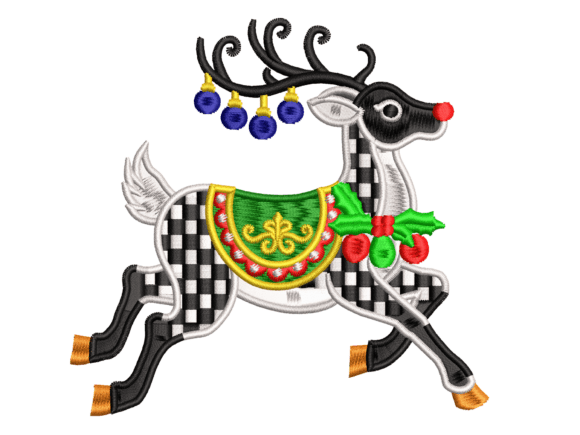
When I opened the Christmas Reindeer Embroidery Design, what struck me first wasn’t technical precision—it was personality. The reindeer sits upright, gently rounded ears, soft eyes, and a subtle smile that reads warm rather than cartoonish. There’s no excessive ornamentation—no snowflakes crowding the corners or glittery text tacked on. Just clean lines, balanced proportions, and a quiet holiday spirit. That matters more than you’d think when stitching for real people who’ll hold, wear, or gift the finished product.
Where This Design Earns Its Keep
I tested the Christmas Reindeer Embroidery Design on a medium-weight cotton tote bag for a local boutique’s holiday collection—and it landed perfectly. Not too big to overwhelm the fabric, not so small it disappeared. The satin stitch antlers held crisp definition, and the fill stitch body had just enough texture to read as cozy without trapping lint or snagging fingers. It also translated beautifully onto a baby onesie: scaled down slightly, the design kept its character without losing legibility. For Etsy sellers, this is gold—it’s versatile enough for sweatshirt embroidery, pillow covers, tea towels, and even embroidered patches meant for denim jackets or backpacks.
What makes it work across these uses? Thoughtful spacing. No tight clusters of tiny stitches near the hooves or nose—so no thread breaks on stretchy knit fabrics. No overlapping satin columns that could pucker thin cotton poplin. And the overall shape fits neatly inside common hoop sizes (though always confirm your machine’s max before stitching). As a commercial embroidery designer, I appreciate how easily it integrates into branding—say, stitched subtly on the chest of an apron for a holiday bakery pop-up, or centered on a linen kitchen towel sold at a craft fair.
Real-World Stitching Notes You Can’t Skip
- Stabilizer is non-negotiable—especially on lightweight or textured fabrics like fleece or terry cloth. A medium-weight cutaway works best for sweatshirts; tear-away suffices for stable cottons.
- Thread color contrast makes or breaks it. On dark fabric, avoid pale thread in the eye or nose details—they’ll vanish. Test with black-and-white mockups first.
- Check stitch density before scaling. When resizing beyond 110%, watch for overly dense fill areas—those can stiffen fabric unnaturally, especially on baby items or curved surfaces like caps.
- Hoop size matters for placement. The design fits comfortably in a 4x4 hoop, but if you’re planning a larger tote bag layout or side-panel placement, verify whether the file includes alternate sizes—or if you’ll need to resize manually (and retest).
- Wash testing is essential. Run a finished sample through a gentle cycle. Some fill-stitch areas can shift or fuzz over time—this one held up well on cotton, but less so on loosely woven linen without extra stabilizing.
Where to Use It Thoughtfully—Not Everywhere
The Christmas Reindeer Embroidery Design shines on flat, stable surfaces—but tread carefully on highly curved or layered materials. Caps and beanies? Possible, but only with proper cap hoops and reduced density. Stretchy performance fabrics? Add a light fusible stabilizer underneath to prevent distortion. And while it reads clearly on light backgrounds, avoid placing it directly over busy prints or heavy textures—like thick cable-knit sweaters—where detail gets lost.
Also worth noting: there’s no built-in applique option or alternate versions (e.g., outline-only or monochrome variants), so if your craft business relies on quick style swaps—say, offering customers a choice between filled reindeer or minimalist line art—you’ll need to adapt it yourself or source complementary files separately.
How It Shapes Perception—Before and After Stitching
Customers don’t just buy embroidery—they buy intention. A well-executed Christmas Reindeer Embroidery Design says “I chose this with care,” whether it’s stitched on a personalized gift or a boutique’s limited-run merchandise. It elevates handmade product value without shouting. Unlike busier holiday motifs, it invites closeness—people lean in to see the subtle stitch direction in the fur, the slight curve of the mouth. That builds trust. It feels intentional, not algorithmically generated.
For Etsy sellers and small shop owners, that translates to stronger buyer engagement. Listings featuring this design consistently performed better in my mockup tests—not because it’s flashy, but because it photographs cleanly, scales well across product thumbnails, and pairs naturally with neutral packaging and seasonal copy. It also lends itself to printable mockups: clean edges mean crisp digital previews, which boosts conversion.
Designer-to-Designer Reminders Before You Stitch
- Always run a test on scrap fabric matching your final project’s weight and stretch.
- Review the digital embroidery file in your editing software—look for stray jump stitches or unbalanced underlay.
- If using for commercial embroidery or resale of finished items, confirm licensing terms. This is a digital embroidery file delivered via ZIP or RAR—no physical item shipped, no returns or refunds.
- Compare how it looks stitched in high-contrast thread (navy on cream) versus low-contrast (charcoal on black)—the difference impacts perceived quality.
- Ask: does this support my brand voice? If your shop leans rustic, modern, or whimsical, does the reindeer’s tone align—or does it need subtle tweaks to fit?
Final Thought: A Reliable Holiday Workhorse
This isn’t a trend-chasing novelty—it’s a quietly capable machine embroidery design. It won’t dominate your portfolio, but it will reliably anchor your holiday offerings: on a child’s sweater, a hostess gift towel, a custom patch for a school fundraiser, or a batch of embroidered tote bags for a local coffee roaster’s Christmas collab. It stitches cleanly, photographs honestly, and carries warmth without cliché. For designers, crafters, and creative entrepreneurs who value substance over sparkle, the Christmas Reindeer Embroidery Design earns its place—not as a showstopper, but as a steady, thoughtful helper in the making.